
Wild Things
When they married, Frida was already here.
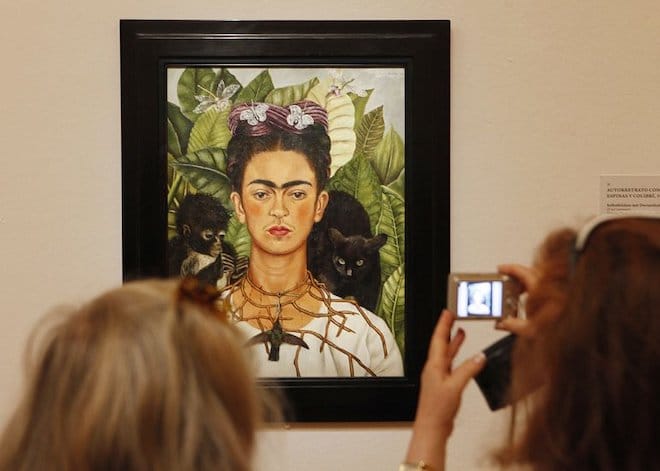
after Self-Portrait with Thorns and Hummingbird, by Frida Kahlo (Mexico) 1940
NB: The Frida Kahlo painting featured in this story was purchased by her friend and former lover, American photographer Nickolas Muray, and was kept in his living room for the rest of his life.
The past is the present and future, always; yesterday marks her territory in the portrait that lords over their living space. Every day, Frida’s steely eyes and unibrow follow Margaret from room to room. The unwavering determination there, that Aztec Nefertiti, throat swallowed by thorns and surrounded by black cats and birds and glistening foliage. Queen of the jungle, queen of pain.
Margaret’s love exists only in her shadow, with her permission. She is her castoff. The leftovers. In the evenings, Margaret and Nickolas read together, or entertain Nikki’s photographer friends, in Frida’s presence. In the early days, when she was feeding little Mimi, Frida’s glare bitterly declared her own empty womb.
When they married, Frida was already here, waiting for her, staking her claim. Nickolas had finally broken things off after a long affair that survived Frida’s marriage and divorce and several of his own wives. Everyone except Nickolas knew Frida belonged only to Diego, no matter who else she loved. When the news came that she would remarry Diego, Nikki finally understood. He withdrew, and their correspondence turned from passionate to friendly.
Clearly, though, he couldn’t live without her: he paid for her most recent self-portrait and installed it over his library and an array of conch-encrusted idols and a Bambara antelope. It was an impressive display of art but even so, Frida was the only one there.
Of course Margaret knew that Nikki spent much of his time with other women. His eye for beauty was his soul, and drove his camera work. Artists and actresses sought him out for fashion spreads and magazine portraits. He studied the bodies of dancers and the faces of models for a living, and for a life.
But there was something sterile in these exchanges, even when he followed those beckoning into the boudoir. It was only Frida that threatened her, the one imperfect body among them, the spindly legs and metal spine. The scars crisscrossing every inch of her like the necklace of thorns. Once, Frida took shears to her prize torrent of black hair, and still she wore the tattered shards like a crown. She did not even wax her moustache. The cluster of silver rings and ancient jade beads retained their magnetism, like amulets, like a shield. Perhaps it was her hunger. Nothing could obliterate her power.
Mimi is now a young woman and her father, an old man. The letters have stopped coming, and that is how Margaret knows Frida is dead. He never speaks of it, but still she senses something missing in him, something hollowed out of his core. When she brings it up, Nikki just says rotely that Frida’s suffering is finally past. Margaret asks, for the first and only time in fourteen years, if he would like to move her portrait to another room, to avoid the constant reminder of the loss of his friend. Nikki tells her coldly that the portrait will hang where it is until the day he dies.
They are mostly happy, Nikki and Margaret. There are many ways in which they have been good for each other. Perhaps love is always like this, wild and complicated, underscored, overshadowed, haunted, enmeshed. She thinks of Frida, fierce, feral, free. And still tethered by crutches and braces, by the storm of her own story, Diego taking up with her own sister and his parade of muses. Diego, married again, before her fire has even turned to ashes.
Lorette C. Luzajic reads, writes, publishes, edits, and teaches short fiction and poetry. Her work has appeared in hundreds of journals, two dozen anthologies, and has been translated into Urdu, Arabic, and Spanish.


