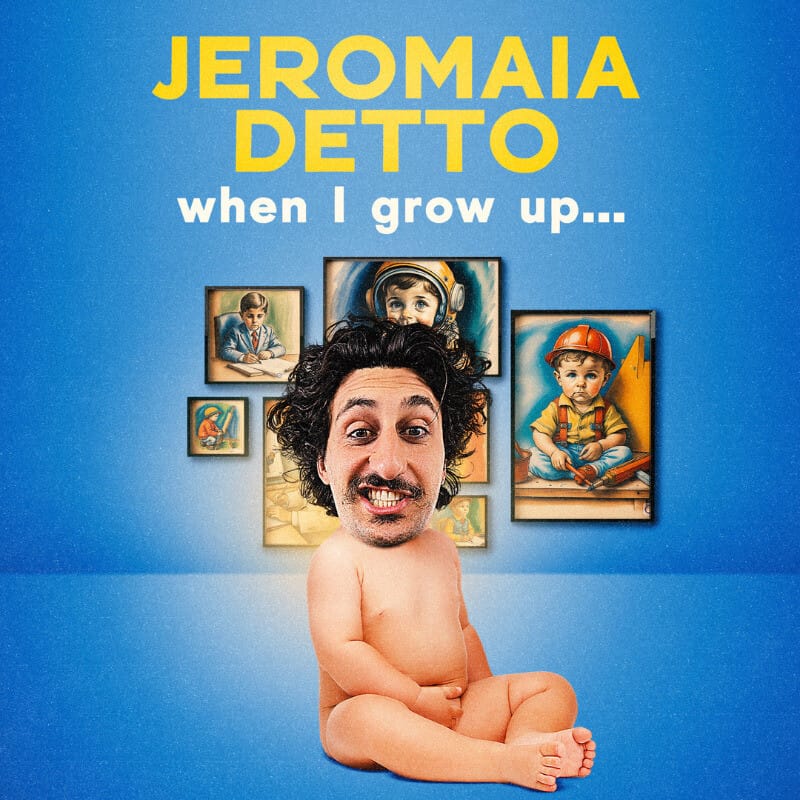
When I Grow Up—a small show with a big heart
When I Grow Up premiered at the 2024 Melbourne Comedy Festival, it returned for the 2025 Melbourne Comedy Festival and Edinburgh Fringe, among others.
by S.M. Rosen
In his moving and playful show, When I Grow Up, Jeromaia Detto shows us what could have been. Pulling scraps of paper scribbled with childhood dreams out of a magic, silver bucket, Detto conjures characters up from a bottomless box of costumes, and the recesses of his remarkably quick imagination.
When Detto offered me a free ticket to see his (then new) show at the 2024 Melbourne Comedy Festival, I wasn’t quite sure what to expect. I had met this charming and talented clown at an improv competition at the Adelaide Fringe—which he won in a landslide. So, I knew that it would, at the very least, be funny. What I couldn’t predict, however, was the keen vulnerability and wisdom at the heart of Detto’s work.
The first few moments of the show feature Detto sitting amongst the audience, in a conspicuous false nose and glasses, wondering aloud when it will begin. It is only when he approaches the stage himself, shows us the empty bucket labeled with a sign that reads “when I grow up I want to be…”, and places a secret entry of his own inside, does the audience feel comfortable enough to begin writing their childhood dreams down. Waiting in the queue for the pen and paper, I wondered which dream I should put into the magic bucket. The 5-year-old’s dream of becoming an archaeologist, the 15-year-old’s dream of becoming a writer? I am lucky enough to have become both of these childhood dreams—having shelved a growing career in archaeology for a shot at the other. But what did I want to be in the future? Had I really grown up yet? Is this all I will be?
Coupled with a sound tech who is as much a character in When I Grow Up as Detto, we see him bring our childhood dreams alive on stage. Whether that dream was a radio DJ, an astronaut, or the Tooth Fairy, nothing is too silly, serious, or surprising for Detto. At the end of each skit, the audience is asked to place his performance on a scale of “Funny” to “Not Funny” through a round of applause. The show does not end until each dream is realised for a few glorious moments, at which point it becomes clear that Detto’s own entry is actually a phone number. We witness him call it and, finding himself speaking to his mother, he asks if it’s okay that he has grown up to be insert funniest skit of the show here.
My own mother once told me a (fictional) story of a clown called Betto. He was famous across the world for his portrayal of pain, beauty, and laughter. When a man went to his therapist and said that there was simply too much pain in the world to see any meaning anymore, the therapist said he should go see Betto perform—“Betto can show you how pain and meaning coexist.” To which the man replies in frustration, “but that’s me, I’M Betto!” Nobody had recognized him without his red nose and makeup.
Clowning has never simply been about laughter, and being a clown has never, ever been simple.
Much like the apocryphal Betto, Detto reveals a complex internal truth through his work. Yes, it is delightful and frenetic. And yes, you will leave the theatre a lighter and freer version of yourself than when you went in. But, to discerning viewers, there is a kernel of yearning at the centre of Detto’s premise. Wrapped up in well-earned laughter, this is a demonstration of the pain we inevitably feel when we learn that childhood dreams vanish, or perhaps worse, that once pursued, they will disappoint those most important to us. It is no accident that he ends each show with a phone call to his mother, asking her if it’s okay that he has grown up to be “an archaeologist penguin farmer from Texas”—if she is proud of him. No matter how fervently she says “yes”, it is easy to imagine Detto making a version of this phone call at the end of every show. “Mum, is it okay that I’ve grown up to be…” a butcher, baker, candlestick-maker. How many yeses will she give before he believes it? How many yeses do any of us need to hear before we feel proud of ourselves?
When Detto begins his show, sitting among the audience in his false nose and glasses, we are asked to consider how we might also be actors in his performance. And through this, Detto demonstrates a profound vulnerability; he removes his disguise for us, unmasking a truth about himself. Here we see a man who will be anything you want him to be, just so long as it’s “Funny”, asking us to identify in ourselves the ways in which we have performed, and conformed, in the pursuit of growing up.
Very few of us will dream of becoming a clown, but each of us will have our own funny-to-not-funny-spectrum to negotiate, with or without the applause of an audience to guide us. A poet might wonder if their work is beautiful or not beautiful, a banker lucrative or not lucrative, a scientist significant or not significant. We will all have a phone number that we would like to call just to make sure we got it right. And after the curtain, even many months later, Detto will leave you wondering: where do I seek the applause in my own life? Whose phone number would I have called if it were me?
It is an affronting thought—and it is a thought that I have witnessed other, internationally celebrated performers struggle to navigate with the ease that Detto demonstrates. In a headlining act of the 2025 Melbourne Comedy Festival, on a stage much larger than Detto’s, a famous comedian told the audience that his jokes are for himself, and that we were only there to hitch along for the ride. This conceit is the through-line of the show, the audience becoming part of the performance, but this time as a punchline. From this headlining comedian’s perspective, the real applause he seeks is internal, the connection between performer and audience is severed. And while this other comedian tells us quite a lot about himself during his act, even having seen it, I still feel that I know nothing about him at all. Wending my way through the crowded Melbourne laneways after I exited the theatre, I found myself reflecting on lessons I had learned the year before from a very different show, in a much smaller venue, tucked away down the street. Comedy is empty without empathy; performance is cheap without sacrifice.
I feel that have the privilege of knowing Jeromaia Detto the man, at least a little bit. What strikes me most, perhaps, is the way he approaches sacrifice and how this shines through his work as a clown. He understands the risk that pursuing creative dreams might mean giving up society’s stereotypes of success. When an audience member put “retired” in the magic, silver bucket, Detto quipped “a 401k, what is that?” He then presented us with an elderly character attempting to paint while racked with the spasms and pain that come with age. The audience, as always, was in stitches. But I believe there is something deeper to be learned beneath the laughter here. To create only once he is grey, tired, and in pain is a sacrifice this artist cannot make. To Detto, art cannot be made in the margins of one’s life, fed on scraps of leftover time. And in making such a decision, any artist may be required to risk the privilege of a 401k—or, perhaps, a mother’s pride.
When I Grow Up is a goofy, sometimes raunchy, always touching, treatise on sacrifice. At its heart, it calls us to acknowledge the sacrifices we have made (and continue to make) in order to grow into ourselves, whoever and whatever that may be. Even, and especially, when those sacrifices fill us with joy. For if there’s a clown who can truly show us how dreams, sacrifice, and laughter coexist, it’s Detto.
Now, if you’ll excuse me, I need to go call my mother.
S. M. Rosen is a poet, illustrator, and award-nominated university lecturer, working primarily in prose poetry and lyric fiction. Her creative work can be found in the Ustinovian Magazine and her slim volume, Conjunction, published by Ellipsis Imprints in 2023.


